July 28, 2018

The 1976 Out-Of-Nowhere Jams

1976 was one of the loosest years for the Grateful Dead's improvisations. They still had a lot of freedom in their setlists, and as in 1974, they could drop an unexpected jam anywhere in the second set. (This looseness faded away in 1977, as the shows became tighter and more structured.) These jams often weren't linked to specific songs as in the past, but were individual pieces of their own, played one night only as between-song transitions and then disappearing.
1976 was full of unique improvs: several songs customarily had extended ending jams in 1976 – Scarlet Begonias, Crazy Fingers, St. Stephen – and other new pieces like Slipknot could be very jammed-out. (But these I won’t be discussing here.) The Dead also had a strong tendency towards mellow spaciness in ’76, with many drifting transitions between songs. Many versions of Playing in the Band this year dissolve into quiet, barely-there spaces. And some of the jams listed here are also rather low-key and lacking in energy, perhaps downright sleepy. But this isn’t a list of the Greatest Jams of 1976, just specifically the jams that are unique and not song-based.
A couple noticeable changes from 1974: the two drummers, creating a constant pitter-patter and sometimes musical dissension as they drive the band, but also still able to make quick shifts. Keith’s approach has also changed since ‘74, as he sticks mainly to basic chord backings in the jams – sometimes taking the lead, but more often creating a repetitive feel. Nonetheless, he still plays a large part in these jams.

6/28/76 Happiness Is Drumming
There’s a bass/drum interlude out of Eyes, which the drummers guide into Happiness Is Drumming. The band fully plays the piece, clearly familiar with it – they had played a brief, uncohesive tease of it in the 6/22 Playing in the Band (14 minutes in) – and it dissolves into Wharf Rat.
(Mickey had already recorded his own vocal rendition of Fire on the Mountain, but here the Dead play the instrumental piece as on the Diga Rhythm Band album, where Garcia had played guitar. Garcia had also played it live with the Diga Rhythm Band back on 5/30/75.)

6/29/76 Jam out of The Wheel
The Wheel is embedded in a lengthy Playing in the Band, but the Dead take a detour on the way out of the Wheel. Garcia starts hinting at the Other One six minutes into the Wheel, which turns into a new fast-paced jam with a driving piano riff from Keith. (He’d play it again on 7/17 and later shows.) This wraps up around 11:50, returning to a regular Playing jam.
(The Wheel was played inside Playing in the Band several times in 1976; another example was on 7/14/76, which has a lengthy spacy jam after the Wheel heading back to the reprise, but there I would argue that this is part of the usual Playing jam, not a distinct piece.)

7/16/76 Jam in Playing, Spanish Jam          
Eight minutes into Playing in the Band, Phil starts a new bass riff which sets the Dead tumbling off in a new direction. This has often been called a Stronger Than Dirt jam in the past, but it’s not – it’s a unique piece. After about six minutes, the Dead pass into a quiet space until Garcia starts Cosmic Charlie.
Later, after Samson & Delilah, the Dead drift into a few minutes of barely audible space; Weir starts up the Spanish jam (for the only time in 1976), and the Dead latch on for a full band jam, until stopping for a drum break.
(Also later on, the Wheel outro is unusually extended, though it doesn’t get into a new theme before turning back into the Playing reprise.)

7/17/76 Jam out of Comes A Time, Jam out of Eyes
First there’s an extended jam out of Comes A Time, which isn’t a new theme but stays within a two-chord structure. (Another extended Comes A Time to check out is 10/15/76, which all but explodes before seguing into Franklin’s Tower.)
An unusually expansive Other One (for the year) follows; then around 8 minutes into Eyes of the World, Keith starts a jaunty chordal riff which initiates a new jam. (This is the same part Keith had played back in the 6/29 Wheel.) The Dead linger there for a while, until Garcia feints at other songs – back to Eyes, then Goin’ Down the Road – and they tumble back into the Other One.

8/2/76 Jam out of Might As Well, Jam out of Wharf Rat
Instead of ending Might As Well, surprisingly, the Dead launch into a bluesy groove for a few minutes, wrapping it up with Samson & Delilah. Afterwards, Wharf Rat is part of the Playing in the Band suite; at first it seems like they’re heading back into a Playing jam after Wharf Rat, but instead it turns into a groovy bass/drums interlude. Phil starts a catchy riff, and the band joins in for an extended funky jam. This is outrageous - Garcia even uses a slide for part of it, before guiding the others into Goin’ Down the Road. After that song, they finally return to a great Playing reprise jam. Only audience tapes are available, so this wild set begs for an official release.

9/25/76 Post-Drums Jam
This is very short; after a bass/drums bit that sounds like it’s starting off Samson & Delilah, Phil kicks off the 8/2/76 riff again. The band joins in but they only play it for a minute before veering into the St. Stephen reprise.

9/28/76 Jam out of Samson, Jam out of Eyes
The entire second set is a Playing in the Band suite, I think for the first time in the Dead’s history. (Actually they’d done it before on 10/20/74, but with fewer songs, in a three-set show.)
An extended Wheel jam segues seamlessly into Samson & Delilah, but a surprise twist comes after Samson, when the Dead immediately start up a neat, virtually standalone jam. I’d call this a continuation of the Playing jam since it doesn’t have any distinct theme of its own; but in any case, it leads into Comes A Time.
Later, after a nice coda for Eyes of the World, the band again jumps into another jam (called the “Orange Tango Jam” on Dick’s Pick 20). Again, I think this is simply the Playing jam continued, but here the jam centers around a unique slinky rhythmic motif. Once this winds down, the Dead start Dancing in the Street, then return to the Playing reprise.

10/3/76 Jam out of The Wheel, Jam out of Good Lovin’
About 5:30 into the Wheel, the Dead start spinning off into another jam; eventually Keith sets the rhythm with a driving piano part (reminiscent of 6/29 & 7/17). It peters out after a few minutes, leading to a bit of uncertainty and some Dancing teases, before they spring the first Good Lovin’ since 10/20/74.
As Good Lovin’ ends, they just keep jamming; about six minutes in, Keith brings back that familiar piano riff again (and for a minute it almost sounds like ‘Take Five’ in 4/4 time). This winds down into Comes A Time, which doesn’t stretch out too far with a short transition jam before seguing into Dancing in the Street.

10/10/76 Jam out of Dancing, Jam out of The Wheel, Jam out of Stella Blue
About ten minutes into Dancing in the Street, Garcia breaks it down into a mellow little jam, very similar to Franklin’s Tower, and even brings out the slide for a bit. This turns into a lovely transition to Wharf Rat.
The second set features another big Playing in the Band suite. The Wheel carries into a few minutes of jamming, perhaps a Playing jam, which turns into a spacy Tiger (one of few in ’76) before collapsing into a drum break and the Other One. Later, after Stella Blue, there’s a couple minutes of jamming which could simply be part of the Playing reprise, but is more like a distinct piece in its own right (Keith’s familiar riff reappears yet again), before they yank it back to the Playing theme.


A few other short '76 jams are also worth mentioning - not really distinctive standalone pieces, but still unusual. 

7/18/76 Jam out of Let It Grow
A note for Dark Star watchers: this jam into Wharf Rat is all but a straight Dark Star for a couple minutes before it veers decisively into Wharf Rat. (You can hear it clearly after 4:20 in Let It Grow.)
There is also a strong Dark Star tease at the end of the 6/12/76 Wharf Rat, about 11 minutes in. No doubt these were accidental teases, since Wharf Rat and Dark Star are musically so close.

10/1/76 Jam out of The Wheel
The Dead have a little musical quarrel after the Wheel – the band starts up a Dancing in the Street reprise, except for Garcia who isn’t interested and wants to play a ballad instead, setting off on his own path. A couple minutes of musical searching ensues; nothing really gels, but it’s an interesting little transition jam, and Garcia finally gets the others to settle into Ship of Fools before they return to Dancing.  (This show is also notable for one of the longest Slipknots of the year.)
https://archive.org/details/gd1976-10-01.sbd.miller.112800.flac16

12/31/76 Jam out of Good Lovin’
A unique arrangement for Good Lovin': after a conventional solo, the Dead suddenly break into a new passage (from about 2:30 to 3:10) that sounds more like it belongs in the middle of Here Comes Sunshine; then when Good Lovin’ ends they return to it, turning it into a funky little Dancing-type jam, which after a couple minutes seamlessly blends into Samson & Delilah.
(Various odd jams are tucked into this show, from a Playing that gets more heavy and percussive as it goes along, to a Slipknot that suddenly turns into a quiet space midway through.)
https://archive.org/details/gd76-12-31.preFM.warner.18524.20760.sbeok.shnf
 

I’ve probably overlooked some other standout jams, so if another jam belongs on this list, let me know!

These kinds of surprise jams mostly died out in 1977, where the improvs were mostly contained within song structures and an occasional “space” transition. A couple notable exceptions:
3/20/77 – a classical Garcia/Lesh interlude at the end of the Other One
12/30/77 – a unique jam after Eyes of the World

It was common for Garcia to play long, spacy transitions into or out of his songs in ’76. I haven’t attempted to list these, since I don’t consider them distinct pieces – they’re generally just one or two minutes long, Garcia’s way of pausing and setting the mood before starting another song. (Wharf Rat, for instance, often had a spacy outro that would meander into the next song, and sometimes extended intros as well.)
One good example is the end of Eyes of the World on 7/14/76:

This tradition spottily continued into 1977. Often in early ‘77 Garcia would embark on a solo “space” passage within the Other One, but sometimes he did it as a transition between songs. Here’s a partial listing of those transitional ’77 spaces – sometimes Garcia solo, sometimes with the band:

3/19/77 – Eyes>Dead space>Dancing
5/3/77 – Eyes>Space>Wharf Rat (great duet with Phil)
5/11/77 - Uncle John>Garcia space>Wharf Rat
5/22/77 - Eyes>Garcia space>Wharf Rat
5/28/77 Not Fade Away>Dead space>Wharf Rat 
6/4/77 – Franklin’s Tower>Dead space>China Doll (could be labeled a Playing jam)
10/29/77 – Eyes>Dead space>Stephen (by now, much more like the Spaces of later years)

June 30, 2018

The Proto-Solomon Jam

In 1972 and ’73, a unique jazzy riff could be heard in many Other Ones and Dark Stars, introduced by Phil Lesh and developed into a recognizable theme jam by the Dead. It was born in the late summer of ’72, gradually altered and changed shape until reaching its fullest form in the summer of ’73, then passed away that fall. It’s never really had a good name to identify it, so for convenience I’m calling it the Proto-Solomon Jam.

Why that title? The origins of the proto-Solomon jam are hotly disputed. There are a couple possible antecedents Phil may have derived it from:

Footprints, the Wayne shorter composition (on the Miles Smiles album), which Phil quotes in the 4-11-72 Truckin’:
A more bouncy, up-tempo version is played briefly in the 4-16-72 Good Lovin' - this is shorter, but closer to the later jam:

Or, the bridge bassline from Clementine, which Phil nabbed from Coltrane’s version of Greensleeves (on the Africa/Brass album). He plays it in the 11-19-72 Dark Star:
(After a brief tease at 6:50, Phil starts the Clementine bassline at 8:50 and plays it off and on for a couple minutes.)
A hybrid of the Footprints and Clementine lines was played in the 4-26-72 Other One - for Phil, these two riffs could easily shade into each other:
https://archive.org/details/gd1972-04-26.sbd.backus.12884.sbeok.shnf (from 18:15 to about 20 minutes in the Other One, track 21, then dissolves in the jam)

Both pieces are in 6/8 time, and the way Phil plays them, each is similar to the other (more than to the originals!) and sound related to the proto-Solomon jam. He may have come up with the new riff by playing around with either of these, or perhaps found it independently since he liked this kind of riff enough to play several different variations of it. (See comment.) As we'll see, the theme changed over time and wasn't locked down to a single unvarying line.

Although he stopped playing it after 1973, did the proto-Solomon theme evolve into anything else? I’ve thought it might be an early version of the Stronger Than Dirt riff – which is not quite the same, but then the proto-Solomon jam went through several forms onstage over the course of a year, and sometimes sounds awfully close to Stronger Than Dirt:   

Some call the repeated riff that ends Eyes of the World in 1973-74 “Stronger Than Dirt,” and the themes are similar (they’re repeated pairs of lines in 7/8 time), but they are separate riffs. See:
In some ways Stronger Than Dirt is a mashup of both earlier riffs, combining elements of both – given that Phil played all these variations on similar themes, it’s probably not possible to draw a straight line from one to the next and nail down their genealogy.

On the other hand, Phil might have just gotten the basic idea for Stronger Than Dirt from the Ajax TV commercial!
https://www.youtube.com/watch?v=EFZK5VkQes4
(Hank Harrison published in his "Dead Book" a page of early-'60s jottings by Phil including the phrase "Stronger Than Dirt!" Harrison wrote, "'Stronger Than Dirt' was an allusion to an Ajax scouring powder commercial of the day. Phil has mentioned that he often heard classical riffs in commercials and this is probably one of them...")  

In any case, on the Blues for Allah album, Stronger Than Dirt was folded into a larger piece, inscrutably titled King Solomon’s Marbles, and even given a subtitle, Milkin’ the Turkey – as with Anthem of the Sun, it seems the Dead went wild naming subdivisions of their songs for the album, until no one could tell what name went with which piece.  
http://whitegum.com/~acsa/introjs.htm?/~acsa/songfile/KINGSOLO.HTM
Hence, the Proto-Solomon’s Jam seems as appropriate a title for the earlier theme as anything (though I'll also call it Solomon's Jazz Jam).

This is a list of all the known versions of the proto-Solomon jam.
I checked most shows from August 1972 through December 1973, and I’m pretty certain these are all the significant times the theme was played in that period. But if I’ve overlooked any instances, please comment!
I did not check Playing in the Band, so it’s possible Phil might have played the theme in those jams occasionally too, though I’ve never come across it there.
I didn’t list brief teases, only times when Phil plays the riff for at least ten seconds. There were plenty of other times when he’d flit through it in a few seconds, and these were not worth listing.
Timings are approximate and may vary.


1972

The theme first emerges in August 1972. 
8-24-72 Dark Star - Phil plays a clear early version near the end, starting around 22:00, off and on for a few minutes. (He inserts a pause in the middle of the riff, so it comes out in a jerky 7/8 rhythm.)
https://archive.org/details/gd72-08-24.sbd.miller.18093.sbeok.shnf

Phil also teases the riff in other shows:
In the 8/20/72 Other One, Phil plays it clearly but briefly around 17:20. At this point it almost sounds like the Seven (which he quotes a minute later). Then in the 8/25/72 Other One, there are a couple hints, most clearly around 8:10, but he only plays it for about 15 seconds.
https://archive.org/details/gd1972-08-20.sbd.miller.83733.flac16  
https://archive.org/details/gd1972-08-25.sbd.miller.92840.sbeok.flac16

In September it's played as a bouncy six-note riff in 6/8 time, but Phil switches it to a 5/4 line later in the fall, with mixed results.
9-19-72 Other One – Starts at 3:50 and keeps going for a couple minutes in a strong full-band jam; they switch to the Other One riff at 6:05.

9-23-72 Other One – First appears at 3:40, Phil plays it for about 15 seconds in scattered fashion; it returns at 7:10, more firmly stated in a band jam that lasts about a minute, and is then reprised at 9:05, continuing for another minute until around 10:00 it blends into an Other One jam. Phil doesn’t stick to the same line throughout, he keeps varying it.

A couple short teases:
9-28-72 Other One – After the verse, around 17:10 Phil plays the riff for about 20 seconds, then moves on. (He repeats it more quietly for a bit at 18:40 but drops it again.)
9-30-72 Other One – In the bass/drum solo, Phil plays the line at 12:25 for about 10 seconds, but passes right over it. (Note that at 13:40 he plays an early version of the end-of-Eyes of the World riff, for about 15 seconds.)

The theme then disappears in October ’72, except for one show:
10-27-72 Other One – Starts at 3:45 and continues in a neat little band jam until it dissolves into an Other One jam at 4:30. This one’s distinctive since it’s played in a slower, swinging 3/4 waltz time.

In the November ’72, the theme recurs in a few shows:
11-14-72 Other One – Phil starts it at 2:10 and continues for about 30 seconds. He sounds like he’s trying to remember how the line goes, or has reconfigured it, and it’s played in loose 5/4 time now. It returns briefly at 3:20 for ten seconds, then again at 4:50 for about 20 seconds, then again after the verse at 7:30, and continues off and on until about 8:50, mingling with Other One lines. The last time around, the band finally joins him in the jam. Phil sounds more stiff now that he’s playing the clipped 5/4 line, compared to the earlier bouncy 6/8 version.

11-17-72 Other One – Starts at 8:45 and continues to about 9:15, with Weir joining Phil, then comes back from 9:40-10:20 in a hot stretch of the jam; and then again after 10:50, Phil keeps repeating it for the next minute, but the others don’t join him. (He throws it in again for 15 seconds at 15:15, then again very briefly at 18:40.) The riff is still in 5/4 time, and despite Phil dropping it into the jam repeatedly, it doesn’t really take with the rest of the band this time.

It’s teased in the 11-22-72 Other One, at 7:50, but only for about 15 seconds.

Then the theme vanishes through December, until the last show of the year:
12-31-72 Other One – Coming out of the bass/drums solo, Phil introduces the theme in 5/4 and the band plays a solid little jam around it until it gradually dissolves into the Other One after a couple minutes (0:00-1:55). At this point it still wasn’t a distinctive theme jam so much as an occasional part of the Other One.


1973

Over the winter and spring of ’73, the jam’s structure becomes more settled as the rhythm changes. In time, it becomes obvious the band has prepared parts for this theme, it’s not fully improvised – Weir usually doubles Phil’s line (or tries), and Garcia frequently plays the same licks each time. Eventually, the jam resembles Eyes in a way, as Phil will repeat his riff a few times, then ‘float’ on one chord for a while before returning to the riff again.

The theme shows up several times in the February/March tour:
2-19-73 Other One – A short but sweet little band jam in 5/4, from 12:55-13:20.

2-21-73 Truckin' – Starts at 10:00; Phil plays it in a halting 5/4 rhythm like he’s practicing the line, and it starts and stops until about 12:00. The band drops out right away so it’s mostly just a bass/drum solo.

2-26-73 Dark Star – In a moment of silence at 10:15, Phil introduces the theme in 5/4, and the band gradually comes in. He pauses at 11:10, then resumes the riff in 6/8 time (adding an extra note – it’s more angular than the ’72 version). This time the band coheres immediately around the theme and they jam on it until 16:20, when Garcia returns to the Dark Star theme. The first full-fledged Solomon’s Jazz Jam. (The playing here reminds me of Dave Brubeck’s ‘Take Five’ – is Garcia quoting the melody?)

2-28-73 Other One – Starts at 4:40, back in 5/4 again. The band dives right into this one and it’s a nice jam, but ends around 6:00 when they return to the Other One theme.

3-15-73 Other One – Starts at 2:45 in a nice little band jam in 5/4 that shifts back to the Other One at 3:20. Then from 4:45 to about 5:50, Phil blends the line into the Other One jam in a very effective way – it actually sounds like it belongs this time, rather than sticking out.

3-21-73 Dark Star – Phil starts teasing it at 6:40, then fully starts it at 7:10, in 5/4 again. The rest of the band rather chaotically tries to join him, but it never comes together. (You can hear someone shouting, maybe an audience member: “Yeah, Phil!”) Phil keeps trying until about 8:20, but Garcia takes them into the Dark Star theme instead.

3-22-73 Other One – Phil teases it at 6:45 for about ten seconds, but there’s a full version from 11:05-11:30. The rest of the band doesn’t really try to join in, so it dies quickly. But this version is important since it’s finally in 6/8 time, and sounds very much like Stronger Than Dirt.

The theme returns briefly in May:
5-13-73 Other One – Just a tease: Phil plays it briefly at 6:45 in shifting time, for only about 15 seconds – it returns for a bit after 7:40, and Phil even switches to a different, higher key around 8:00, but then drops it.

5-20-73 post-Nobody's Fault jam – Phil blends the line into the jam around 5:15. Hard to say just when it “ends” as the bass-line changes but the jazzy jam keeps going.

In June the theme reaches its peak as the band finally plays several lengthy, fully-formed versions:

6-10-73 Dark Star – Phil keeps teasing it for about a minute after 4:55, but the band doesn’t commit, and by 6:20 it’s dropped. Coming out of the bass solo at 10:00 is a full-fledged band version in 6/8, but it only lasts a minute and ends at 11:05. (The band then works up a nice upbeat melodic jam.)

6-22-73 Truckin' – Phil hints it at 22:05, then commits to the theme at 23:00 for a full band jam. This is a very loose version in shifting time – Phil starts it in 5/4, then switches to 6/8. It continues until 26:00, when they head for the Other One.  

6-24-73 Dark Star – Starting at 6:20, this is a faster, more solid and assured version. The guitarists jump in and are committed, and they jam on the theme at length. (Keith seems to sit out until 11:30.) It’s in 6/8 throughout – that is, the bass-line is, but at times Phil will wander around in free time before resuming the riff. It finally winds down around 13:00, and Phil brings the jam to a finish at 13:55; a drum solo ensues.

6-29-73 Other One – There’s a brief Phil hint at :55, but a full-fledged band jam starts at 3:20. It’s very much like the 6-24 version, very structured and mainly staying in 6/8. (But this time, Keith drops out after 5:00!) It breaks down sooner, and the theme finishes at 6:40 as they move on to unstructured jamming.

7-1-73 Other One – There’s a brief ten-second Phil tease at 1:45, but the full band jam starts at 6:20. This is a lot like the last two versions, structured in 6/8 again, but it’s more loose and energetic tonight. (Keith is present throughout.) It continues to 9:30, then Phil switches to the Other One riff. (Just before the switch, he plays a couple shortened lines that sound just like Stronger Than Dirt.)

7-31-73 Truckin' – Coming out of the bass/drums break at 10:45, Phil starts the theme in 6/8; the rest of the band joins in for a loose little jam, not quite the Solomon’s Jazz Jam. Phil drifts out of the bass-line after about 11:15, and the jam ends a minute later.

After that, the theme is heard infrequently in the September & October tours. Over the next couple months, Phil gradually alters the riff again:

9-7-73 Truckin’ – After Garcia starts the Other One riff, Phil pushes his own riff in at 10:10, and the others try joining in, but it’s a scattered mess and they abandon it at 10:35 for a drum solo. Phil briefly toys with it again at 3:15 in the Other One jam, an interesting moment since he drops the line after a few seconds, but Garcia & Weir keep playing what sound like their theme parts for a little while longer until it transforms back to an Other One jam.

9-11-73 Dark Star – The band is vamping away without Garcia; Phil drops in his 6/8 riff at 10:55, and they others join right in and play it for about 40 seconds. This is notable as a Garcia-less version (they’ve fizzled out by the time he comes back at 11:50), and is pretty unremarkable.

9-21-73 Other One – Starting at 5:40, this is a fast, very loose version that doesn't stay in 6/8 but often sounds more like free time. It’s not very tight (Weir sounds rather lost and Phil is low in the mix), but the jam gets hotter as Garcia turns up the energy. It continues up to 9:40, then fades away. (Also note Garcia's great rhythmic riff after 10:30, which Weir turns into a Mind Left Body jam.)

10-23-73 Other One – Teased briefly by Phil at :20, for about 15 seconds, it returns at 1:20 and lasts until about 1:50 before dissolving into the Other One jam. A fast, loose version that actually sounds more like Slipknot in its short duration. Phil is not sticking to the familiar bass-line anymore.

10-30-73 Dark Star – Starting at 6:20, this is another loose & flexible version. It’s no longer in 6/8 or any regular time, and Phil plays around with the bass-line more with lots of variations. Mostly low-key, it gradually heats up, but the band calls a halt around 11:30 and heads in a different direction.

The theme’s last significant appearance is in November:
11-14-73 Truckin' – Starting at 11:45, Phil plays it only until 12:05. This time it sounds just like the old Clementine riff sped-up! (You could hear the previous October versions heading in this direction.) He hints at it again for just a few seconds at 16:10 in Truckin’, as they pass into the Other One; then it briefly pops up again at 4:45 in the second Other One.

After that, there were only a few brief teases of the Solomon's Jazz jam for the rest of the year. Judging by its last few performances, the band had lost much enthusiasm for this theme. I don't think it was ever played as a full jam in 1974. (The 2-23-74 Other One has the last hint that I heard.) But if anyone hears it in later shows, let me know!  

June 19, 2018

1967 Mystery Show Photos

Compiling the list of 1967 shows, I came across photos of several shows that are unknown and undated. I thought I'd post the photos here, in case any readers have clues about the dates!

The first show - in the Panhandle, April or May 1967:


We can generally narrow down a date range for a photo by the instruments the Dead are playing, which changed from month to month. This show was played sometime between 4/9/67 and 5/29/67. The Dead might have played in the park any number of times that spring, but one tempting date was 5/14/67, when Jefferson Airplane are known to have played in the Panhandle with "others" - and photos show the Airplane's truck parked close to the same spot:


But it turns out the Dead photo is from a different day, since they weren't mentioned in a news report of the May 14 show. (For that matter, these Airplane photos may be from a different date as well.)

*

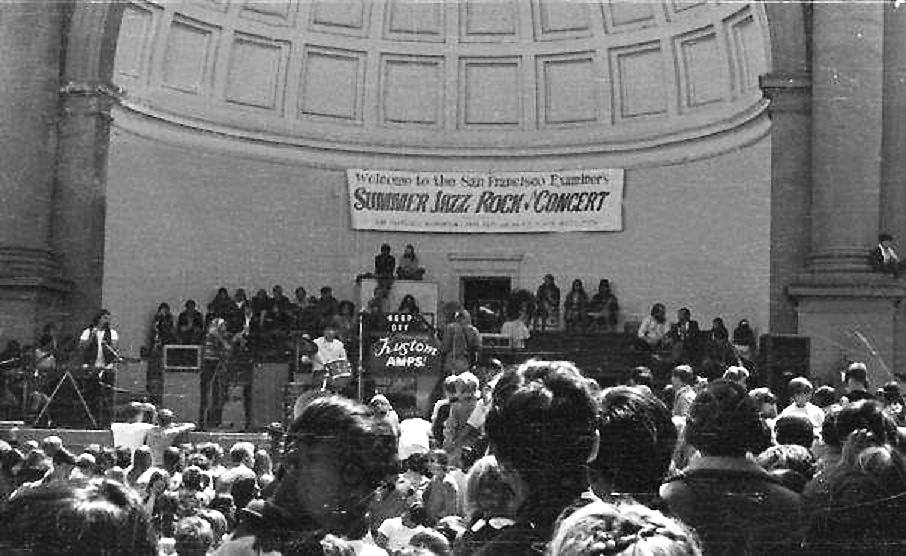
The second show - in the Spreckels Bandshell, Golden Gate Park, summer 1967:


This distant photo doesn't help with even an approximate date, except for the season, but the "Jazz Rock Concert" was clearly a scheduled event, likely with other bands playing as well. The San Francisco Examiner probably had a listing for the concert which can be found - although the Dead may have substituted for a different band.

UPDATE:
This concert was on July 6. An Examiner listing has been found:

"ANOTHER JAZZ-ROCK
Once again tomorrow, from 1 to 3 p.m., another in The Examiner's summer-long free jazz-rock concerts will be held in the band concourse at Golden Gate Park.
Featured band will be the famous Warner Brothers' recording stars the Grateful Dead, acclaimed as one of the foremost groups in the hard blues-rock tradition known around the world as the "San Francisco Sound."
Joining with the Dead will be the Mt. Rushmore group, among the strongest of the newcomers on the local rock-concert scene and recent participants on another peak, Mount Tamalpais.
Be our guests: bring the kids, a picnic lunch, and enjoy your park, and your music.
Joining The Examiner as sponsors are the San Francisco Youth Association and the Recreation and Park Department." 
(from the S.F. Examiner, July 5, 1967)

*

The third show - somewhere in August/September 1967:


This photo was published in the Taping Compendium, labeled only "Paloma, California, circa 1967." The photographer was Don Snyder (who published a similar shot in his 1979 book Aquarian Odyssey).
There is no chance the Dead ever played in the town of Paloma, though if the label's right, it's possible they might have played in some venue or area called "Paloma" or "La Paloma," of which there are many in California. Snyder was visiting the Bay Area from New York and didn't necessarily keep a good record of where he took his photos; but he definitely photographed Chocolate George's wake in Golden Gate Park on 8/28/67, so this show is thought to be near that date.
If it's not from an unknown show, it could possibly be from one of the Lake Tahoe shows the previous weekend, or from Rio Nido the next weekend. I'm uncertain how far outside San Francisco Snyder would have traveled, though.

*

The fourth show - in Golden Gate Park, June or July 1967. This was a large event with many photographers present:


Considering the size of the crowd, other bands probably played as well. Jack and Jorma from Jefferson Airplane were there, though I don't know of any photos of the Airplane playing:


There was at least one mystery player who appeared on stage before the Dead:


These photos were formerly thought to come from the 6/21/67 Summer Solstice festival in the park, until film of the Dead's actual 6/21/67 performance appeared. So this show was played sometime between then and the brief Northwest tour in mid-July. No Golden Gate Park appearance is known in that time range, though it's surprising that an event this size never appeared on any Dead show lists. (Whenever some of these photos are posted online, they're generally labeled as the January Be-In, which is not the case.) My speculation is that this was some forgotten Fourth of July celebration in the park.

UPDATE: 

Correspondent Dan Sullivan writes: 

I've been doing photo research and writing captions for a forthcoming book, Jim Marshall's Grateful Dead, and one of the photos that's been impossible to date accurately is the one of Jorma, Jerry and Jack giving Jim the finger at that mystery free show in the park.  

Well, I recently came across a contemporary mention of a free show in the park on July 4th, 1967.  It's in the "Ad Libs" event listings section of Ralph Gleason's SF Chronicle column the day prior (7/3/1967, page 29):  
 
"...there's free music in Golden Gate Park all day tomorrow in the meadow where the Summer Solstice was held.  Free food, too.”

Baron Wolman's logbook says this concert took place on July 4th, 1967. He says it's the Human Be-In, which is clearly wrong, since that took place in January.  And Ron Rakow's Relix article gives the location as Speedway Meadows. 

Now, Gleason doesn't specifically mention the Dead playing on July 4th.  But they were in town, having played a free concert in Palo Alto on Sunday, July 2nd and about to play another free show at the Golden Gate Park bandstand on Thursday, July 6th.  

The Airplane had finished a short Midwest tour in Beloit, WI on Sunday the 2nd, as noted here:

Assuming they flew home on Monday the 3rd, Jorma and Jack would have been in town to hang out in the park on Tuesday, July 4th.  

Regarding the specific location, it's clearly not the wide-open Polo Fields, per the photos looking out from the stage.  

A contemporary handbill for the Summer Solstice show says: 

"...the day long festivities will begin throughout the park. There will be a barbecue picnic celebration East of the Polo Fields at noon."  

Speedway Meadow is directly east of the Polo Fields (Lindley Meadow is to its north).  

So, I conclude that Baron Wolman has the correct date but the wrong event.  And Ron Rakow has the correct location: Speedway Meadows, now known as Hellman Hollow, which is where the food was happening during the Summer Solstice concert in June.  And that's the date/location we've gone with for the book!

*

If anyone knows what dates the other shows might be from, please comment!